If you exit the site, your Wishlist will not be saved.


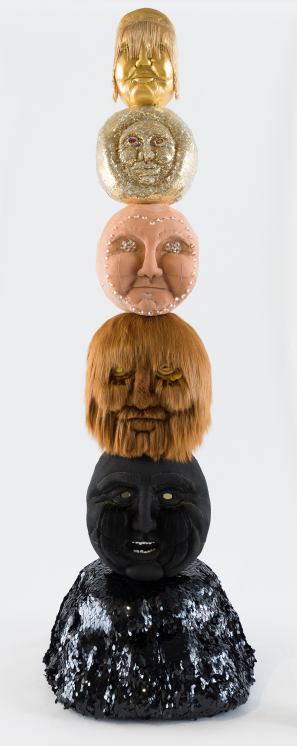
Deatil view of Tarryn Gill, 'Family Totem', 2016-17, Foam, nylon, faux fur, sequins, polyester thread, plastic and glass gemstones, glass mirrors, fimo, plastic buttons. Photo courtesy of Artbank.
Embargoed until 9.00pm Thursday 21 April, 2016
Today, Artbank, one of Australia’s key national art institutions, announced the commission of a new sculpture as part of a significant new initiative, The Artbank Sculpture Commission. The commission will be a new work by award winning Western Australian artist Tarryn Gill.
The Artbank Sculpture Commission is an ongoing initiative to support artists to realise the creation of new medium to large scale contemporary sculpture. The Commission will see a series of emerging and mid-career Australian artists supported to produce ambitious sculptural works – extending on their area of practice - for the Artbank collection. Once complete, the sculptures will be made available to the public for rent through Artbank’s art leasing program. The works commissioned through this initiative will complement Artbank’s already significant holdings of sculptural objects collected over the past four decades.
The Artbank Sculpture Commission is a commitment to ensure the medium continues to flourish and new talent is recognised, nurtured and encouraged through the support of cultural institutions like Artbank. Tarryn Gill’s commission is the second such award; the first was won by sculpture and performance artist Mark Shorter in late 2015, unveiled at Artbank’s Renny Kodgers & Friends event on Thursday, 21 April 2016.
Says Artbank director Tony Stephens: “The Artbank Sculpture Commission ensures we maintain a collection that is representative of the best of Australian sculpture - while also providing the opportunity for artists to push themselves that bit further with our support. Mark Shorter’s playful and evocative work Big Pinky is an exciting way to kick off the commission and we eagerly await the outcome of the second commission – just announced - by celebrated Western Australian artist Tarryn Gill”.
Says Tarryn Gill, winner of the second Artbank Commission: “I'm so excited to have been approached by Artbank to work on their second commission. It's a dream and a total privilege to have the chance to create a piece specifically for this culturally significant collection of Australian Art. I’m looking forward to spending time with this project and creating something truly memorable for the public to enjoy through Artbank’s leasing program.”
Tarryn Gill is a multidisciplinary Perth-based artist, producer and performer with a background in dance and musical theatre. Since 2001 Tarryn Gill and artist Pilar Mata Dupont worked together in a practice that encompasses photography, performance, choreography, film, installation and design. Gill and Mata Dupont’s staged investigations into nationhood interweave references to Hollywood glamour, burlesque, Australiana kitsch and social realism. Gill and Dupont’s video work Gymnasium 2010 won one of Australia’s most prestigious art awards, the Basil Sellers Art Prize, through the work’s exploration of historical uses of a fascist aesthetic in propaganda, as well as the cult of the heroic Australian athlete.
In 2013 Gill undertook a residency at the Freud Museum in London. After being privy to Freud’s personal collection of Greek, Roman, Egyptian and Asian antiquities and the studio of his daughter and fellow analyst, Anna Freud, Gill created a series of highly acclaimed sound sculptures for the 2016 Adelaide Biennale of Australian Art, Magic Object. Titled The Guardians 2015 these stitched and sewn sculptures are reminiscent of characters found in folktales, pop culture, myths and legends and emit anthropomorphic sounds from their uncanny forms. Like the objects in Freud’s possession, Gill’s eerie works appear like seers or prophets. Their strong and powerful presence is similar to the Japanese tomb ornaments known as Haniwa, which are arranged around a burial site, in order to both protect the dead but also drive away evil.
Like psychoanalysis ran in the Freud family, Gill’s forbearers worked with their hands as seamstresses, knitters, carpenters and leather smiths. Gill’s grandfather was also deaf which required the artist to communicate with him through sign language. It is not surprising that hands and handwork have particular significance for her, both personally and artistically. As writer Ted Snell writes ‘Her self-reflexive interrogations into the rituals we construct around life and death combine personal memories with characters drawn from mythology and funerary art to activate the space between the earthly and other-worldly, where we can re-examine, rethink and reimagine our identity.’
More info on Tarryn: http://tarryngill.com/about-Tarryn
For over 35 years, Artbank has been at the forefront of the Australian contemporary art sector. Established in 1980 as a federal government support program, Artbank provides direct support to Australian contemporary artists through the acquisition of their work and promotes the value of Australian contemporary art to the broader public. Artbank funds its operations through a unique leasing programme; working with individuals, companies, governments and embassies in over seventy countries across the globe. With approximately 10,000 works by over 3,000 artists, Artbank holds one of the largest collections of Australian contemporary art in the world, which includes some of the best examples of Indigenous and non-Indigenous artwork produced over the past four decades. As the largest collector of Australian art in the country, Artbank’s support for artists is often applied early in their careers, with further acquisitions made at regular intervals to form an extensive and constantly evolving collection of Australian contemporary art.