Notice

Please view this in chrome if you are having any issues with how the website displays

Notice

This website uses cookies, utilised by us and third parties to enhance your experience. Learn more about how this website uses cookies on the departmental website.

News and Media

List of News and Media Articles

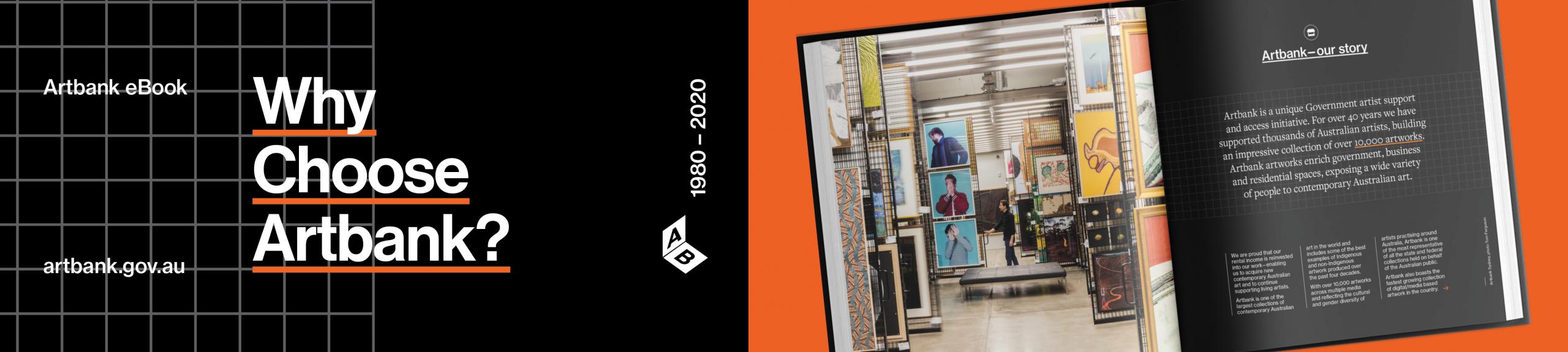
  • why choose artbank?

    Artbank is a unique Government initiative supporting Australian artists and giving you an affordable opportunity to enjoy art in your home or business.

    Find out more about our leasing program below - please click in the centre to view at full screen 

  • nishi

    New Artbank selection at NISHI.

    Artbank turned 40 in August 2020. As part of its celebrations, the team at Artbank has selected new works for display in our home department at the NISHI building.

    Highlights include a stunning hang of early bark paintings from Arnhem Land by masters such as Lofty Bardayal Nadjamerrek from Gunbalanya (formerly Oenpelli), David Malangi from Ramingining and Djambawa Marwili from Yirrkala, and a collection of bold, playful sculptures that enliven the office. 

    The digital brochure available from the link below will provide you with detailed information about each artwork, and with more information about the federal government arts support program that is Artbank.

    Image: Kunmanara (nellie) Stewart, Minyma Kutjara, 2010, Synthetic polymer paint on canvas

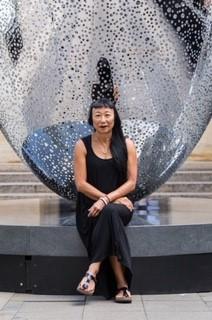
  • Artbank Artist Profile: Lindy Lee

    "One of the essential threads in my work concerns my split identity as a Chinese-Australian artist. This question of ‘split-ness’ is also an intrinsic part of the Australian psyche. The essence of Australian society is multiracial and culturally diverse. Having work like mine in the collection means that Artbank recognises the importance of presenting this diversity.  Artbank needs to be ‘broad and eccentric’ otherwise it would be a very hollow group of works"

    Lindy Lee

    Lindy Lee

    What is your relationship to Artbank?

    My work is represented in the Artbank collection. It is one of the most extensive and inclusive national collections in Australia and presents an in depth profile of contemporary Australian art. It’s a very important collection for any artist to be in.


    When was your work first purchased by the Artbank Collection? Do you remember your response to that purchase? 

    Art bank has been collecting my work since 1991. I was still a young artist so it was a very important boost to my confidence. Often artists work very much alone. Sometimes it’s difficult to maintain a creative practice in isolation. I remember that the purchase validated my practice. It wasn’t just about the financial support but that there was also a critical acceptance of my work.


    The Artbank Collection is a broad and even eccentric collection. How would you characterise your own work? What is the importance of your work we have in collection to you or to the collection.

    One of the essential threads in my work concerns my split identity as a Chinese-Australian artist. This question of ‘split-ness’ is also an intrinsic part of the Australian psyche. The essence of Australian society is multiracial and culturally diverse. Having work like mine in the collection means that Artbank recognises the importance of presenting this diversity.  Artbank needs to be ‘broad and eccentric’ otherwise it would be a very hollow group of works.


    What does being in a national collection mean to you? Do you feel that your work has a connection to Australian stories?

     I studied in London as an art student for a few years in the 1970s. Curiously it wasn’t until I returned To Australia that I understood the content and the direction that my work needed to take. It was all about ‘identity’ and the nature of ‘self’. Foe me, building an authentic practice could only happen in the context of this country - Australia where all my formative experiences happened. My story.....my family’s story of transition, migration, experiences of racism and acceptance is part of the Australian story.


  • Rachael Mipantjiti Lionel, 'Kapi Wankanya', 2018. Synthetic polymer paint on canvas.

    Rachael Mipantjiti Lionel, 'Kapi Wankanya', 2018 (detail). Synthetic polymer paint on canvas.

    Since its inception in 1980, Artbank has been leasing artworks to the Department of Foreign Affairs and Trade (DFAT) for display in many Australian diplomatic missions and posts across the world. Artbank’s partnership with DFAT is a long distance relationship that has grown with numerous artwork exchanges and thousands of air miles, helping to showcase Australian contemporary visual art to the world. Artbank artworks enable the sharing of ideas, identities, cultures and arts practices and can open a dialogue when there is no shared language. Art can be instrumental in fostering mutual understanding and building relationships. Through art we can see ourselves and see others and define our place in the world and the values we hold in it.

    Australia’s rich and diverse arts sector is an enormous asset to our international relations, especially Australia’s Indigenous artists whose voice can shine the light on traditions, trade routes, and cultural ties, tens of thousands of years older than any being discussed in today’s news.

    Artbank currently has nearly 1000 artworks placed in 70 diplomatic posts across the world. From the Cook Islands to Mongolia, from London to Cairo, Artbank artworks play a vital role in our international relations while bringing joy and a little piece of home to far-off shores. 

    Ambassadors and their staff regularly approach Artbank to view the extensive collection and to piece together a story that tells of Australia’s vibrant contemporary arts culture, our Indigenous history of many millennia, as well as the more recent rich multicultural connections that make up our society and tether us to nations across the globe.

    Like Australia, China has a sophisticated artistic tradition going back thousands of years. This was an important connection to make when Beijing Embassy Manager of Public Diplomacy, Sarah Schmidt, along with Artbank consultant, Courtney Kidd, curated the collection of Artbank artworks to be featured in the Australian Ambassador’s official residence in Beijing.

    The Australian Embassy in Beijing has always featured a wonderful array of contemporary art from the Artbank Collection thanks to the leasing program. This new selection was a celebration of this long-standing relationship.

    Dr Sarah Schmidt, explains

    "These artworks represent remarkable contemporary Australian painters, Indigenous and non-Indigenous, such as Rachael Mipantjiti Lionel (b.1976) and Phillip Wolfhagen (b.1963) among others.

    The way that Rachael Mipantjiti Lionel’s 2018 Dreaming painting Kapi Wankanya and Wolfhagen’s Tasmanian landscape Sixth Illumination (1996) relate in the installation, is notable: Indigenous and non-Indigenous works, of differing landscape traditions in conversation, each with a painterly style that is somewhat intangible or evocative.

    Rachael Mipantjiti Lionel, 'Kapi Wankanya', 2018. Synthetic polymer paint on canvas.

    Rachael Mipantjiti Lionel, 'Kapi Wankanya', 2018. Synthetic polymer paint on canvas.

    The selection also includes some key figures representative of the development of Australian Aboriginal art, such as George Milpurrurru Garr - Spiders (1983) for bark painting and Mick Namarari Tjapaltjarri Untitled (Women’s Dreaming) (1985) for the Western Desert art movement.”

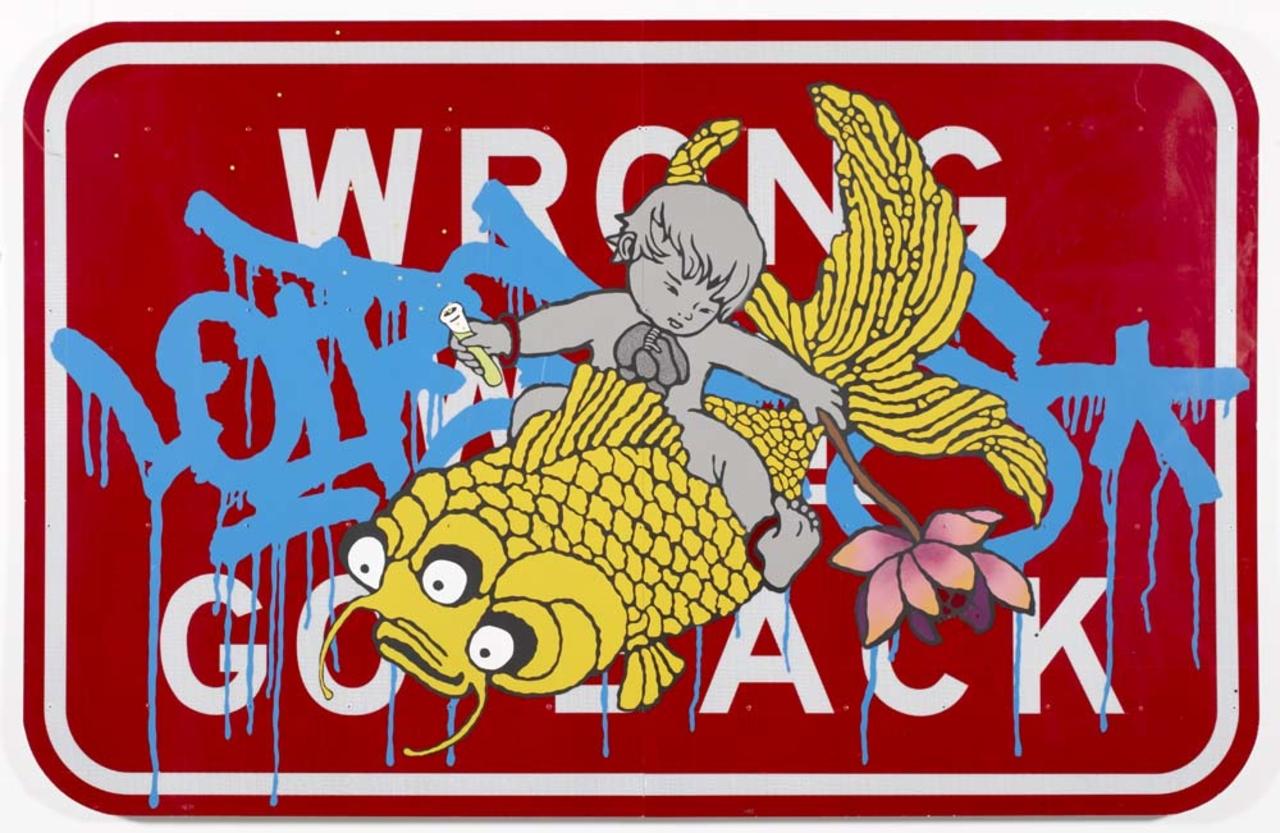
    The Artbank collection celebrates Australia’s multicultural arts sector which in turn reflects Australia’s diverse population. Chinese Australian artists have long played a part in our national and international arts scene. In another recent collaboration with Artbank and DFAT’s National Foundation for Australia-China Relations, a number of Chinese Australian artists - Guan Wei, Dongwang Fan, Louise Zhang - were curated alongside Australian Indigenous artists Keith Stevens, Ginger Wikilyiri and Dhambit Mununggurr. Another artist who featured in the selection was Jason Wing with his work Parramatta Dreaming. Wing’s father is Chinese and his mother is an Aboriginal woman from the Biripi people in the Upper Hunter region of New South Wales. In his art practice, Wing pulls apart his own bi-cultural identity, Indigenous political identity, environmental awareness and exploration of street art culture. His work is edgy and contemporary and uses motifs from both of the ancient cultures he straddles. The selection of Artbank artworks celebrate this unique cultural relationship between China and Australia.

    Jason Wing, 'Parramatta River Dreaming', 2010. Spray paint on aluminium.

    Jason Wing, 'Parramatta River Dreaming', 2010. Spray paint on aluminium.

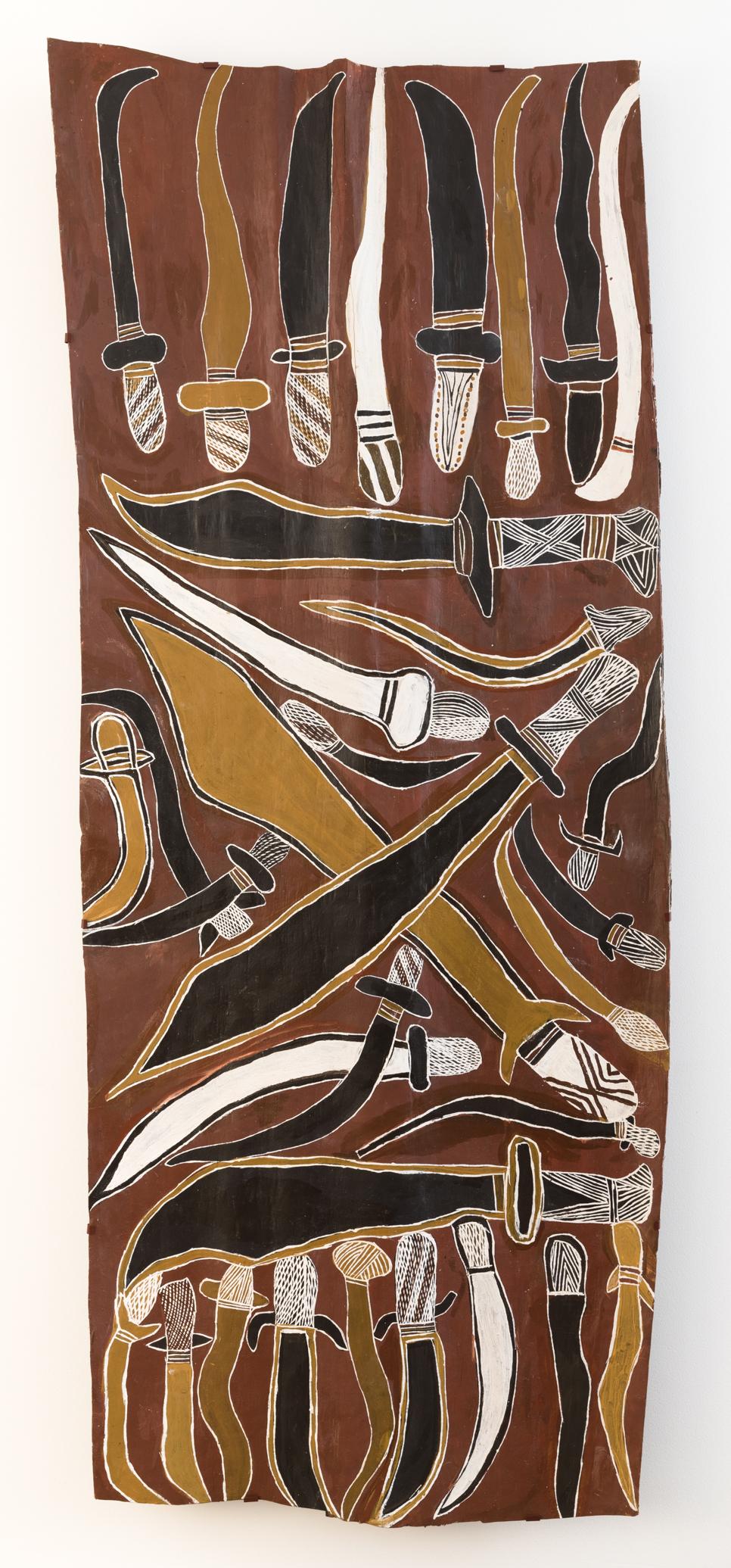
    Although not always the top criteria for collecting, Artbank curators will often consider the cultural ties an artist or an artwork may have with our International Embassies. The recent acquisition of Yolngu artist Dhuwarrwarr Marika is an incredible contemporary work that references the very first trade relations between the Yolngu people on North East Arhnem land and Makassan sailors from Indonesia. Marika paints the Makassan swords and long knives that were traded for trepang (sea cucumbers). This retelling of these early cross cultural exchanges are told defiantly throughout Yolngu and Makassan stories and also act as a modern day reminder of the cultural connections to our closest neighbours.

    “Yolngu invited the Makassan people to their camp and explained to them who they were. Makassans explained who they were and why they came. In their heart they were Yolngu people. The Makassan taught the Yolngu their song and traditions and the Yolngu taught the Makassan their culture and law and tradition.” – Dhuwarrwarr Marika, artist statement, Telstra National Indigenous and Islander Art Award, Museum and Art Gallery Northern Territory, 2019.

    Dhuwarrwarr Marika, 'Makassan swords and long knives', 2019. Natural pigments on stringybark.

    Dhuwarrwarr Marika, 'Makassan swords and long knives', 2019. Natural pigments on stringybark.

    The Department of Foreign Affairs and Trade (DFAT) was Artbank’s first client and, to this day, is its largest. Artbank and DFAT work together to ensure Australian contemporary art is represented in our embassies and high commissions across the world and helps foster important creative exchanges between countries. Artbank is proud of its role in foreign diplomacy, deepening cultural connections and raising awareness of our vibrant arts culture. Something Artbank will continue to celebrate during its 40th anniversary year.

    Dr Sarah Schmidt is an Australian curator and public gallery director of twenty years experience who has curated this selection from the Artbank collection, as Manager Public Diplomacy, The Australian Embassy, Beijing. She was previously Director of Hamilton Gallery and Deputy Director of the Art Gallery of Ballarat.

    Being an international curator, Sarah found Artbank's extensive database indispensable, being able from her office in Beijing to select works to represent our nation in China. Sarah expressed being very pleased with the tremendously efficient assistance of Courtney Kidd and Zoë Rodrigeuz who ensured the timely delivery of artworks to China to fit the Embassy’s timelines.

  • orchard piper banner

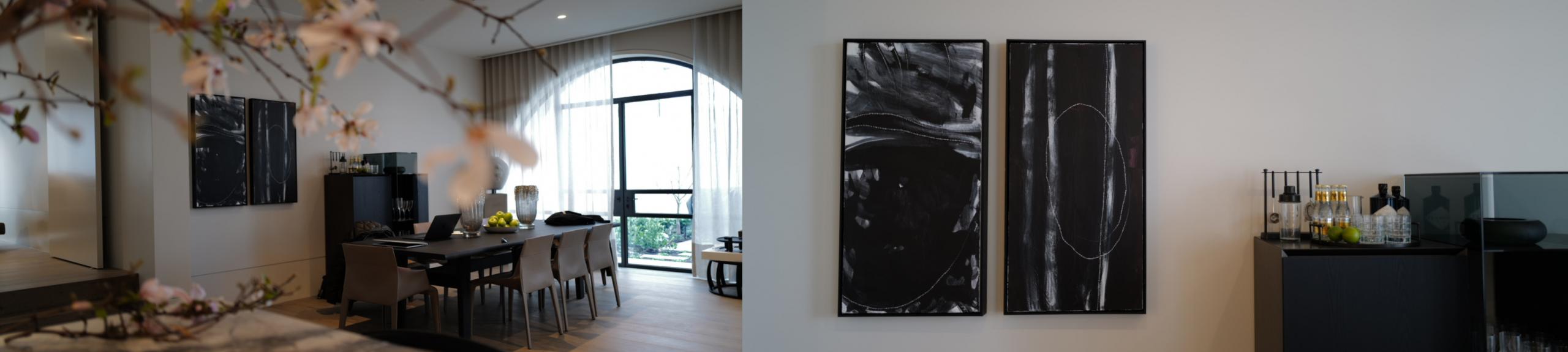
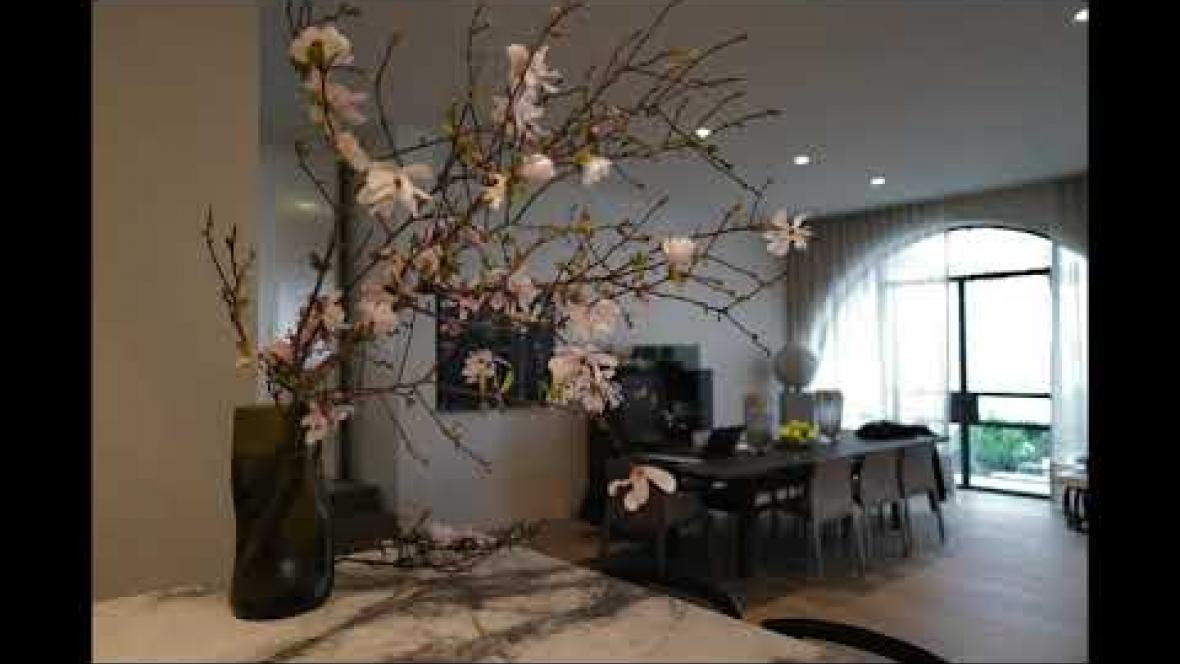
    Artbank was delighted to curate a beautiful selection of works for Orchard Piper’s latest project 35 Huntingtower Road with Poliform Australia. 


    35 Huntingtower Road comprises of 10 boutique residencies in Armadale, Victoria. The selection features newly acquired works by emerging artists Adam Stone, Ali McCann and Michael Georgetti alongside many Artbank favourites.


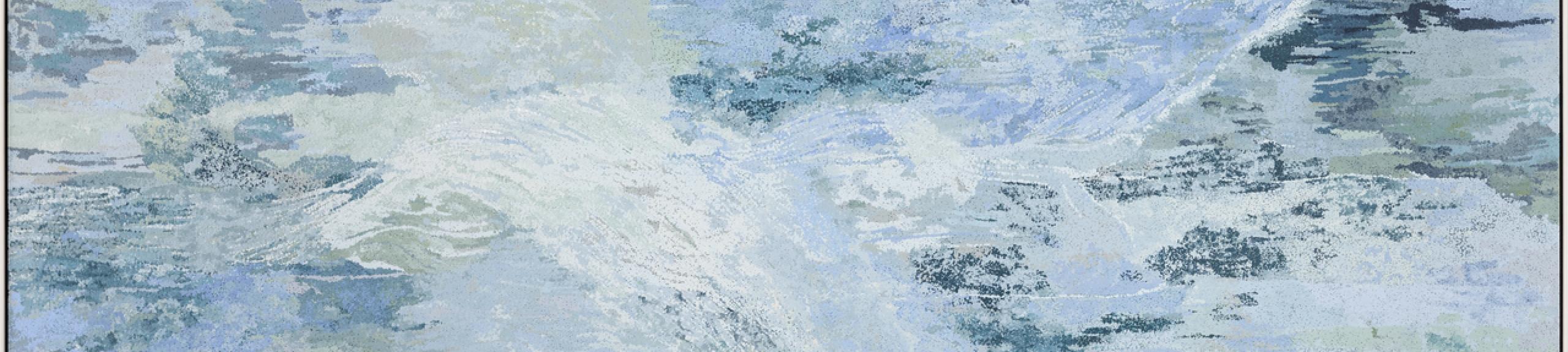
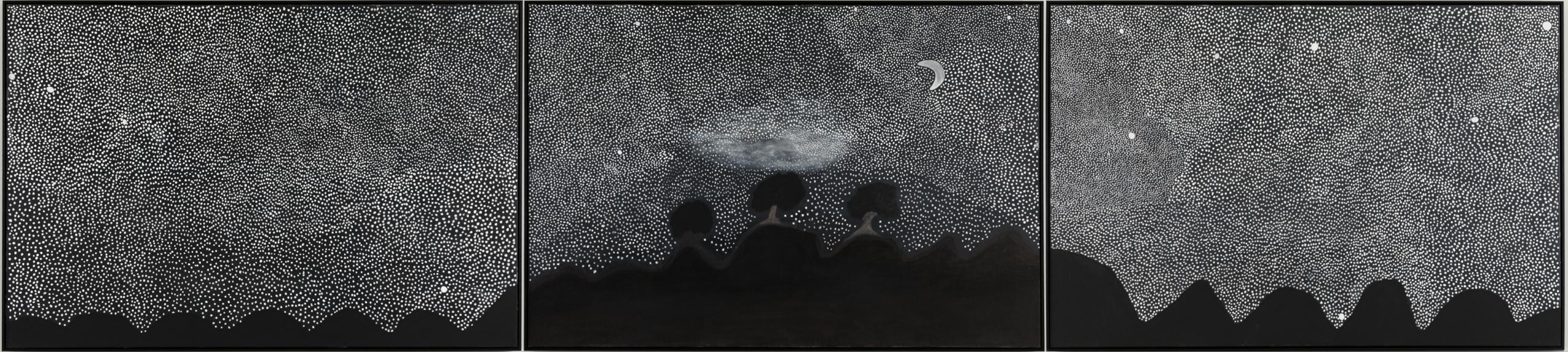
  • Rusty Peters Three Nyawana in Yariny Country, 2018

    Rusty Peters, 'Three Nyawana in Yariny Country', 2018, Ochre on canvas. Photo courtesy of Artbank.

    The Artbank collection holds works by some of Australia’s most significant artists. These works promote the value of Australian contemporary art to the broader public via our leasing program. However, on some occasions Artbank is able to loan our collection to curators, galleries and art institutions to be seen by an even larger audience.

    In one of our most recent loans we see Artbank’s stunning triptych by Mr R Peters tour across Australia in an exhibition titled Void, supported by M&G NSW, UTS Gallery and Bathurst Regional Art Gallery. Void is curated by Emily McDaniel an independent curator, writer and educator form the Kalari Clan of the Wiradjuri nation. The exhibition explores the spaces left by artists and the powerful presence this unknown fills.

     “Art is defined as much by what it is, as what it isn’t. Artists express what we don’t have words for and that’s certainly what you’ll find with the Indigenous artists that have been included in this exhibition.” Emily McDaniel

    Artbank acquired Three Nyawana in Yariny Country by Mr R Peters in 2018. The work is three panels and over five metres long, however - the vast blackness of the canvas is seemingly endless as it engulfs the viewer in a dark blanket of piercing stars.

    It is this blackness that Emily McDaniel is searching in her touring exhibition – Void.

    “the void isn’t empty space, it’s filled with significance, we just need to change the way we think.” Emily McDaniel, 2019.

    Mr R Peters was a senior Gija law man from the East Kimberly. He began painting at Waringarri Aboriginal Art Centre in Kununurra in 1989, along with Rover Thomas. His works were grounded in Gija law, his strong knowledge of Country and culture as well as his personal history as a stockman and activist.

    In this work Peters paints Garnkiny or moon Dreaming as it appears to the artist in his own Country, Yariny. The underpinning story of the landscape is one informed by Gija kinship/skin system, specifically the taboo governing a mother-in-law and son-in-law.

    For more information about Void and the touring schedule.

    mgnsw.org.au/sector/exhibitions/now-showing/void/

  • Celebrating 40 years of Artbank

    Artbank Profile: James (Jim) Kenney

    Deputy Director and first Curator of Artbank

    1980 - 1996

    Interviewed by Artbank Director Zoë Rodriguez

    You are described in your handwritten notes as the Deputy Director and Curator for Artbank. (These were probably written in 1981 or 1982). When did you start at Artbank and what was your role?

    I started at Artbank mid-July 1980. My commencement date was delayed a few weeks while I stayed at the National Gallery of Victoria on a secondment arrangement with the Commonwealth. During this time, however, I was able to attend the inaugural meeting of the Artbank Advisory Board in Sydney, as curator-designate, and I ran a few Artbank errands in Melbourne. So, it was a gradual immersion in the new job.

    One of the errands run in Melbourne was to meet Ken Cato. He and his associates had just completed the mammoth job of creating the logo and visual identity of Commonwealth Bank so it was particularly kind of him to do the same for Artbank at ‘mates-rates’. I remember that I had envisaged something more fluid and maybe light-hearted but when he pulled back the black covers on the presentation board it was a magic moment. Artbank suddenly seemed real, a ‘thing’.

    At that inaugural meeting of the advisory board it was also decided that my ‘local designation’ would be Assistant Director. In such a small organisation multi-tasking was vital and the traditional role of curator would have been an indulgence. The new designation sounded ‘grander’ but it was an appropriately vague term for what encompassed wide ranging ‘other duties as required’, as the last line in duty statements usually put it. Effectively I was ‘middle management’ with a hand in everything from changing lightbulbs to entertaining the Deputy Prime Minister.

    Why did you decide to take the role?

    I was aware of the success of the Canada Council Art Bank and, since both countries have similar political and cultural institutions there seemed to be no reason the model would not be a success in Australia. Being able to participate in the establishment of a public institution is an opportunity that comes along rarely. I have said that I was involved in Artbank at its ‘log-cabin’ phase and while the cabin has been replaced its footprint and foundations are still there after 40 years.

    How do you think Artbank is different from traditional public collecting institutions?

    Firstly, I do not see Artbank as a ‘collecting institution’. I believe it is more correct to call it a rental collection or, as some overseas equivalents have done, assign it to its own genre, ‘an art bank’. The universal definition of a collecting institution is one which collects, preserves and interprets. Artbank has none of these responsibilities though it dabbles in all three in a modified manner. It purchases artists’ work as a means of encouragement and promotion but not for posterity. Preservation would likely preclude rental to clients with minimal environmental controls and security. In this regard you might say Artbank is ‘all care and no responsibility’. Interpretation was limited by available resource. In its early days Artbank loaned work to other institutions to supplement their own exhibitions, with their interpretation. In the main, biographical information on the artist was the extent of ‘interpretation’. Artbank mounted some exhibitions from its own collection but these were strictly for the purposes of promoting the scheme.

    What was it like being at Artbank right from the start? Did you have instructions on what to do, or did you have to make up your own path?

    Being at the beginning was exhilarating and there were no instructions other than Artbank’s Charter and budget to constrain us. One very small example that comes to mind was my decision one day to spell Artbank as one word. No one had been doing that and the logo developed for us by Ken Cato and Associates suggested we had leeway. It also suggested the zeitgeist of the 1980s. It remains the convention today.

    Artbank’s charter was generously open with few of the restrictions that even the Canadian Council Art Bank had to abide. For instance, there was no restriction on who could rent from Artbank whereas the Canadian model was restricted to government, charities and statutory authorities. In practical terms however we concentrated, initially, on the government client base since there was a demand that had not been catered to before and, in the commercial world, art was increasingly being seen in the workplace.  Artbank provided the opportunity for our government clients to move away from the faded Tom Robert’s lithographs that typically proliferated.

    In our first three years our ‘technology’ consisted of a Polaroid camera, a memory typewriter (remember those?) and two ordinary electric typewriters, and a phone system. With 40 years of hindsight you have to wonder how we ever managed. It was modest even by the standards of the early 1980s but, then again, computerisation was in its infancy and restricted to much larger business enterprises. At the beginning we requested a computer for collection management but the cost of providing a landline to the departmental mainframe in Canberra was prohibitive. The internet was restricted to universities. Only a few years previously Steve Jobs and Bill Gates had emerged from their garages and revolutionised the availability of computers to individuals and small enterprises so it was becoming increasingly clear that a landline was not necessary but it took a few years more to overcome the reluctance to give an outlying unit of the department data storage independence. The increasing demand for providing statistical answers to ‘Questions on Notice’ in Parliament which required manual counts from our paper index card system finally became too time consuming and impossible for short deadlines and the case for a local system was quite clear. In 1986 a new era dawned when we transferred card-based data to digital format.

    Another aspect of Artbank’s early years was the problem in communicating rental proposals to prospective clients. Today there is the internet but in the 1980s and early 1990s we had to send photographs by post. Colour slides might have given better colour balance but it would have been financially prohibitive to have a large stock of colour slides. Technically it would have been awkward for the client.  But photographs by mail was slow and while a work might be under consideration by one client another might be waiting for a photo.

    Tell us about the first lot of acquisitions for Artbank – they happened in a hurry!

    Graeme Sturgeon had been appointed in April 1980, as I recall, and half of the annual budget for art purchases had been allocated but had not yet been released. In the early months of his appointment his time was taken up administrative matters at the parent department in Canberra. But time was ticking over and the deadline for all FY79-80 expenditure on 30 June. He was getting anxious. Finally, with only two weeks remaining he was given the ‘ready-set-go’ and his bountiful marathon began. Western Australia may have missed out on this first round of spending but he covered most of the galleries in the Eastern states and South Australia in a steak of largesse as far and wide as possible in just a matter of days. I am sure that for the galleries in particular this bode well for the future.

    The first Artbank office was at 44 Market Street in Sydney. What was that like? When did you move to Roseberry and why?

    Initially Artbank was wherever Graeme happened to be, usually his home in Sydney or in Canberra. When I joined in July the three of us (our steno-sec and receptionist Lindsay Collins joined us at this time) were assigned a disused office in the Commonwealth Centre at Chifley Square (now demolished). We sat amongst broken desks and office chairs and with some foraging we found the furniture we needed to set up shop. Our first client visit was to this sorry sight. It must have seemed unpromising but happily he stayed with us as a valued client for many years.

    After a few weeks our new premises at 44 Market Street were available and we moved in to a handsomely fitted out new home in the middle of the city. Clearly the planning had taken place long before and it was woefully inadequate to the purpose despite its proximity to the amenity of central Sydney which was appealing for staff. The store/display room was kitted out with rolling racks but it was no bigger than a suburban lounge room so we rapidly outgrew the space. Being a commercial building, we also had to negotiate and keep on side the man in charge of the delivery dock who would not allow deliveries during the morning or afternoon peak. We also had to contend with packing materials and crates which were difficult to dispose of and certainly impossible to dispose of quickly.

    Eventually we had an opportunity to rent a temporary storage off-site in Paddington. It could accommodate large paintings which the city-site could not but is was not a pleasant place to take clients and getting them there involved a lengthy trip in a Commonwealth car or taxi from the city and then back again.

    The inadequacies of the Market Street location were evident early on and I became aware of a request for a larger space had been lodged with the department that arranged office accommodation. That did not seem adequate to me either so I wrote specification for increased display/storage space and appropriate amenity akin to our growing needs. Happily, this document was found at the top of the file just as the previous request was being looked upon and new premises were leased in Rosebery almost exactly in accord with my revised specification. None of us knew where Rosebery was and it proved to be difficult to attract junior staff but it was handily located nearer the airport and, at last, we had dock facilities with ample room for display, storage and packing. It became home for the next 30 years, hardly what I expected at the time I was drafting the specification.

    Some of the most significant works in the Artbank collection are very early acquisitions from Papunya Tula. Can you tell us about visiting that community and how you went about selecting and acquiring works?

    About 1983 I was invited by Andrew Crocker to accompany him on his return to Papunya where he was the art adviser. Andrew was son of an orchardist in Somerset but he had acquired a commitment to promoting indigenous cultures in Australia and Africa. I met up with him in Alice Springs and with an elder from Papunya in the cab of a truck we set out across the Central Desert to Papunya.

    A few years earlier I had travelled across Africa and the Central Desert was very like the flat arid lands of Chad and Eastern Nigeria.

    I met many of the now-famous artists of the Papunya Tula community nurtured by Geoff Bardon in 1971. I did not see any paintings being painted, or at least I do not recall any, but seeing the environment and meeting the artists was a great privilege. It would also have been impossible to purchase any paintings direct from the artists at Papunya since their cash economy and Artbank’s government purchasing systems were incompatible. This was probably for the better because they needed a reliable system of trustworthy intermediaries with the commercial world and Artbank, I believe, needed to respect and nurture that relationship.

    Can you tell us how Artwork number 1 in the Artbank collection got its number,

    Richard Crichton’s Kangaroo Study No 4, 1980.

    After Graeme’s marathon purchasing trip a few artworks began to arrive at our base in the furniture store room of the Commonwealth Centre. I remember a delivery man bringing in the first four and so I decided to put theory to practice and set about documentation. I think it was probably in a notebook and later transcribed onto index cards which we used until computerisation six years later. Three of the pictures in that first delivery were fairly unremarkable but the fourth was quite remarkable. Richard Crichton’s Kangaroo Study No. 4 seemed heaven sent for the occasion and I chose it for the first number which was 80.000.00 in the old numbering system which became 0001 in the new computer-based system. His image of a kangaroo was strong and seems to be permanently etched into my brain. I suspect if I had had 100 works to choose from that day this would still have been the one I selected to launch the rental collection.

    What are some of your favourite acquisitions you made for Artbank?

    I don’t think I have any particular favourite work but the act of acquiring was often very satisfying since we were reaching out to visual artists who were working away from the state capitals and regional centres and out of that particular commercial loop and the recognition that comes with it. People are making art EVERYWHERE and Artbank is uniquely placed to encourage them.

    While I am not admitting to a favourite acquisition I do confess to some affection for a small painting (the artist will remain anonymous) that seemed to behave like an errant child asserting its independence.

    The painting had been purchased from a Melbourne gallery but failed to arrive and no one in the chain of people involved seemed to know where it had gone. The documentation revealed nothing so that system was reviewed and revised. Some months later I was at government stores at Botany (an industrial suburb near Sydney airport and Port Botany docks) awaiting a rendezvous with someone. I was ushered into a store with caged rooms, one with artworks likely intended for the National Gallery of Australia. While I was waiting, I noticed a room with an open door and only one thing in it, a painting with its face leaning against the wall. I went to have a peek and Aha! The missing painting.

    A few years later the painting came back from a client and when I looked at the reverse side I discovered the hangers had been reversed so it could be hung ‘upside down’. It was an abstract and while hanging it any which way was not negotiable the client evidently thought it was. How long had it been hanging this way and how many viewers noticed that something wasn’t ‘quite right’?

    Who was Artbank’s first client/s? How did you build your client base? (Yours was an enviable rate that we aspire to today!)

    I believe the kudos for ‘First Client’ must go to DR Don Edgar, founding CEO of the Australian Centre for Family Studies. His organisation had been established only a few months before Artbank. He may have become aware of Artbank by word-of-mouth because he contacted us when Artbank was still an idea operating out of a briefcase.

    There was some on-air publicity at the time of Artbank’s official opening (August 8th 1980) and we relied on this for attracting clients. Our budget did not allow for paid-advertising but the host department in Canberra helped feed the media with announcements. I remember arriving in Alice Springs on my first visit there and while unpacking I turned on the television news and heard that I had arrived in town. Channel Nine also had a very well-produced segment which elicited many client inquiries. These media segments were very productive and of course word-of-mouth fed on them. In the early years these were all we needed to generate more than enough client interest at a pace which would not overwhelm the organisation. In fact, about 1984, we had to do our best to cool demand and lie low because stock levels were insufficient to offer clients satisfactory choice. We did not want to have anyone going away unhappy for that reason. All in all, I would say that the demand and supply nexus was in happy balance for Artbank’s early years. Not too much, not too little. Cinderella conditions.

    Who was the most difficult client you had to work with (can just be a general description, rather than a name)

    Most of our clients were delightful and we developed a happy relationship with many who became fans over the years. Selecting artwork is perceived by most as recreational but it is also an opportunity for self-expression as it is for the artists who create the art and, in many enterprises, opportunities for self-expression are few and far between.

    But of course, there are always exceptions. I recall one client who wanted to make a selection and have it delivered all on Christmas Eve! We did it but then waited months and months for the account to be settled. Such is retailing!

    You are from Canada originally. Did Artbank Canada influence your work/ how you established Artbank in Australia?

    I was familiar with the Canada Council Art Bank. There were some differences in the models adopted by the two countries so we grew independently without much direct influence. However, as it happened, the Canadian Art Bank is located in Ottawa which is also my hometown. On many visits home I called in on their Art Bank and in the mid-1980s I spent one month with them sitting in on juries, visiting artist studios and galleries across Canada and getting to know their approach. I found myself feeling slightly awkward since I should try to be a bit more exotic than I was. After almost 50 years in Australia I still do not have a remotely Aussie accent and since one of my ancestors is acknowledged as the founder of Ottawa it was a case of the return-of-the-native. In fact, I was more ‘native’ than any of them!

    Our Artbank was operating on the smell of an oily rag in comparison the Canada Council Art Bank. It had an expensive jury system for acquisitions designed to bring together artists from East and Western Canada as well as from the two linguistic cultures. It dispatched large quantities of artworks across the country (at least once a year) so that clients could make selections without travelling to Ottawa. We struggled on sending not-so-terrific colour photos and perhaps benefitted from being based in a Sydney with a larger local market.

    However, in the early 1990s the Canadian Government, with the Canada Council Art Bank as collateral damage, underwent massive budget cuts to bring down the deficit. The art bank was closed down and staff dismissed. It was revived many months later when it was realised the damage that would be done to the Canadian art market would be enormous if the collection were to be sold. Their model was revised to resemble ours more closely.

    What’s one of your best memories of the 16 years you worked at Artbank?

    Perhaps the most memorable moment of my time at Artbank was the day I left. This might seem an odd thing to say but I was able to look back at an organisation that was viable, firmly established and well regarded. It was on the brink of a more responsive funding model and, thanks to the boys in California and Seattle we were about to enjoy the benefits of computer technology. The internet was not yet a ‘thing’ for enterprises other than universities and scientific institutions but the sense of rapid change was palpable. Had I not begun my Artbank career at the very beginning I might have had a different sense of ownership and satisfaction but on my retirement felt more like ‘Mr Chips’ looking back on my 16 years.

    Can you describe what sort of Director Graeme Sturgeon, our founding director was? What do you think his legacy is for Artbank?

    Graeme understood artists and the cultural and economic environment in which they were working. He had trained in Australia and England in fine arts but decided his vocation lay elsewhere, primarily in art criticism. He certainly was familiar with the length and breadth of the visual arts. He understood the motivation to make art and the difficulties in making it a career. In short, he had credibility with the art community and that was conferred on Artbank.

    Within Artbank he was collegial and fostered a congenial working environment. As one colleague said to me recently ‘we had a good time’. I believe most of us who worked with him have happy memories and that is certainly a positive legacy.


  • Tony Albert

    Tony Albert portrait. Photo: Steed Photography.

    Artbank Artist Profile: Tony Albert

    Interviewed by Artbank's Senior curator Oliver Watts

    "With Artbank, the focus on emerging artists and the stages of artists’ growth within the curatorial rationale gives Artbank a chance to buy things from a particular series or at a point where an artist makes a development in their practice. For example, I haven’t really continued on with the Optimism series, but I look back and they’re little rare gems for me. When you look back at the collection there are one-offs and examples of when an artist was experimenting with something, particularly early in their career, which is what I think makes the collection so important in its entirety"

    What is your relationship to Artbank?

    I was purchased in the Artbank collection while I was an emerging artist, which was a really wonderful opportunity for me at that time and is how I became aware that Artbank existed.

    Do you remember when your work was purchased and where Artbank purchased the work?

    It was the Optimism series so that would have been while I was still living in Brisbane. It was really great for me because it coincided with the Queensland Art Gallery exhibition called Optimism, which was held in 2008. I had made the work for the exhibition, but the gallery was really interested in including one of the more ephemera based works I was making at the time. The work didn’t end up where I intended it to, but I’m really glad it was able to get a voice through a different avenue. It was a really important and special work for me because I was working with my family on it. The work became really quite successful in getting people to understand the importance of using cultural objects in everyday life.

    Did your relationship with Artbank continue after that acquisition?

    Optimism is the only work in the Artbank Collection, but through that initial connection I was able to establish a relationship with Artbank curators that have come since, which has been really nice. They identify with me through that work or through my association with the collection, which is really wonderful – how a collection continues to bring people together long after people come and go.

    The Artbank Collection is a broad and even eccentric collection, how would you characterise your own work and what is the importance of your work to the collection?

    With Artbank, the focus on emerging artists and the stages of artists’ growth within the curatorial rationale gives Artbank a chance to buy things from a particular series or at a point where an artist makes a development in their practice. For example, I haven’t really continued on with the Optimism series, but I look back and they’re little rare gems for me. When you look back at the collection there are one-offs and examples of when an artist was experimenting with something, particularly early in their career, which is what I think makes the collection so important in its entirety.

    Did it mean anything to you to be part of a national collection at that time?

    Absolutely! It was everything for me. 2008 was also the first year I sold a piece to the Art Gallery of NSW (Head Hunter, 2007) and for any artist, being part of a national collection gives immense validation. It is like the pinnacle of what you’re looking for. At that point in my career, the kind of work that I was doing and my contemporaries were doing was challenging and we had to form groups like proppaNOW just to get our voices heard. So when that is reciprocated through institutional recognition you feel like, they are listening to what we’re saying and they are willing to take this work that questions in some cases that authority or way of thinking that questions the validity of us as people. I think this is incredibly important and for me; at that time it was life changing.

    How does your work relate to Australian stories, how does it mediate between the local, the personal and the national?

    The figure in Optimism is my cousin, Ethan and at that point he had spent his whole life in a small country town near where I was born, where I call home. It’s imperative for me in the messaging of Optimism to show that art has made such a huge impact on my life and what I’ve got to do because of it. Each one of those photos was taken in a 3km radius of where I was living in Brisbane, so we literally walked to every location. It was really important to me to not only show members of my family what I do and how I do it, but also to show that art is not hard and art doesn’t have to cost a lot of money. Those are really holistic principles for me as an artist, I always go back to that point and think of what I had at my disposal to make art – and it was not a lot at all – and that never impacted on my ability to make art. That is really important to me.

    Where did the baskets in the work come from?

    That’s actually my Aunty’s basket in the photo that she made for me. Jarwun baskets are so rare and hard to make, they take so much time and effort and probably still don’t have the market value they deserve, like a lot of fibre works or weaving works. We don’t actually understand the time and effort that goes into making them, even just collecting and gathering and then making them, unfortunately it’s a real dying art form. But there are still these amazing people within our communities that are making them to pass on cultural knowledge, it’s not about them selling as artworks, it’s about gifting to family, about teaching young ones the methodology behind it, how to continue to weave that way. It is a basket that is unique to the rainforest of north Queensland, nowhere else in the world are baskets made with that design, so it is something that is really special. I have a small collection of them, which I treasure greatly because they are made by my family. The ingenuity of traditional weaving is exceptional; it challenges all thoughts and stereotypes about what Aboriginal culture was. It was so sophisticated and advanced and you only have to look at those baskets to understand the incredible intuitive nature of the way in which people lived in Australia.  

    Artbank works travel widely domestically and internationally, does your work respond to this concept of accessibility? 

    I hope so! I really look at not only my work, but me as an artist, as that vessel or conduit between two different kinds of people and the knowledge that is spread between is just closing in that divide between who we are as people. It’s about understanding different methodologies, ways of living, differences in life. For me equality exists through the acceptance of difference, it’s about understanding different people. The more breadth and opportunity the work has to be shown, the smaller that divide gets and that’s imperative to us as people, that we have the opportunity to understand each other rather than use those differences as a divide.

    Artbank prides itself on a diverse and inclusive collection. Do you feel your work responds to this issue and if so, how?

    Within the language of art, in particular Aboriginal art, there was this terminology of Indigenous and urban and for me, the differences, even for us as Aboriginal people, that our work brings on a wall whether it be through medium or theme or the stories we’re telling, they actually don’t divide us, they actually bring us all closer together. It’s really important for all art, in the curation of contemporary art, that international art sits with Australian art, which sits with Aboriginal art and when all those different voices are added to the same conversation it becomes much more important and inclusive. It becomes a place where problems can be resolved. That is how I see art and artists, as problem solvers, they really pull apart ideas and then put them back together and it’s through that process we find all these other little nuances, that’s what I really love about art.

    What is your favourite artwork in the collection?

    I’m definitely going to choose a Gordon Bennett – the profound effect someone’s work like Gordon had on me as a teenager, that feeling of isolation that I felt, it was like he reached inside, it was like he was making work that came from me. That is the power of someone like Gordon and that’s why for me his work is so important and in some, possibly even the international realm, it’s still not where it should be, he was a truly profound artist. I don’t think I would be the person or the artist I am today without the influence he had on me, particularly as a teenager, so anything I can do that helps to sincerely portray how grateful I am for him to be part of my life, it’s an honour to do so. It was actually the first exhibition I ever went to, where I literally went and caught the bus and was wondering ‘what do you wear to an opening?’ There is something so intrinsic to the human condition in Gordon’s work, non-Indigenous people actually understand and are drawn to his work and the idea of identity and to me that is really powerful, when you can connect through those issues to everyone.

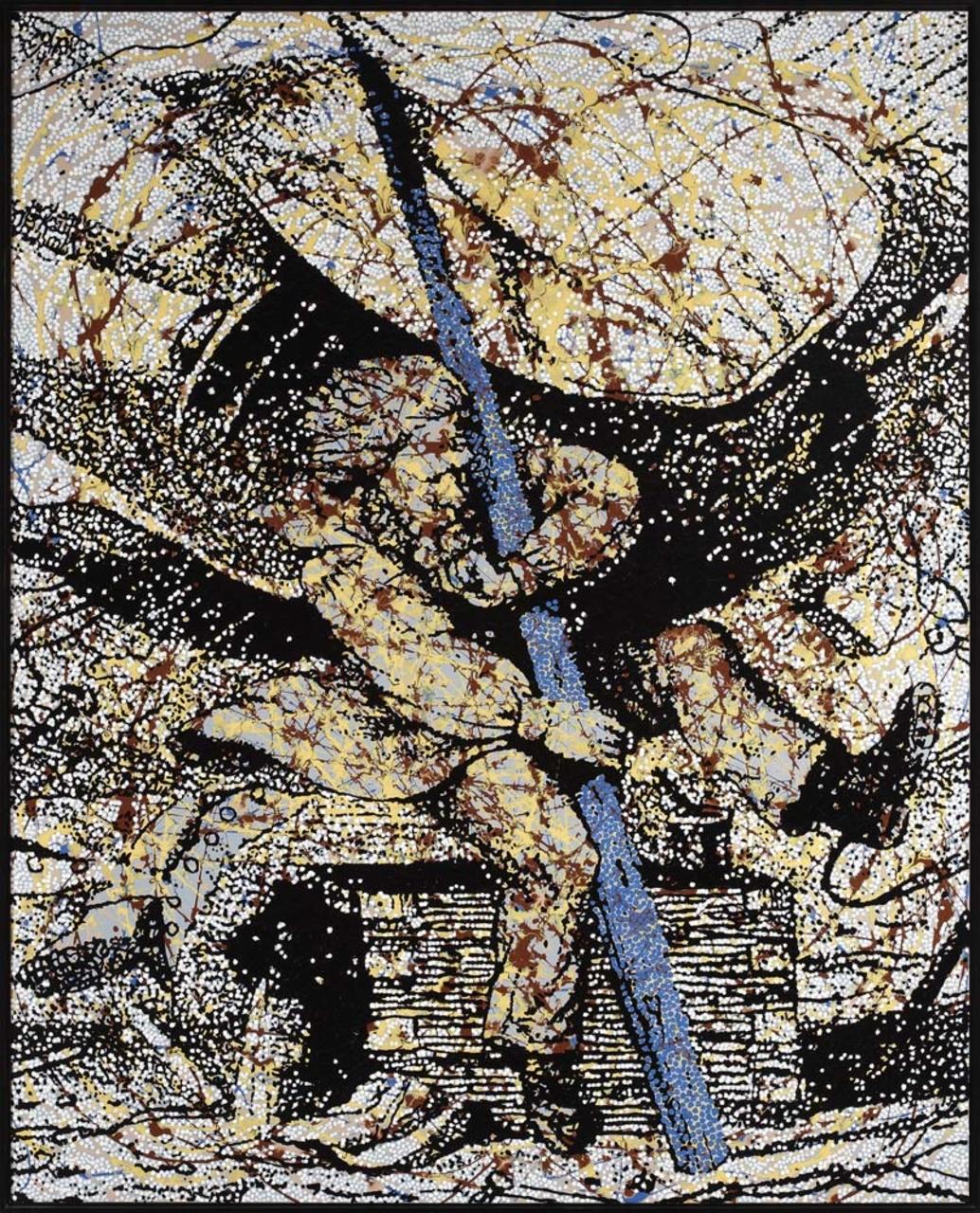
    Gordon Bennett Explorer II, 1991 Oil and synthetic polymer paint on canvas

    Gordon Bennett, 'Explorer II', 1991, Oil and synthetic polymer paint on canvas.

    Gordon Bennett
    Explorer II, 1991
    Oil and synthetic polymer paint on canvas
  • Kate Scardifield, Canis Major, 2019. Photo Robin Hearfield

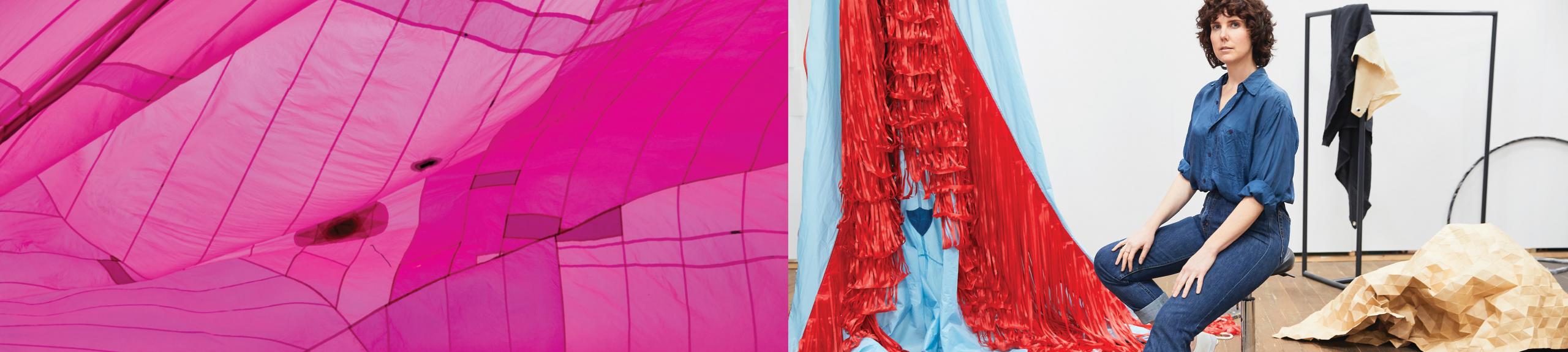
    (left) Kate Scardifield, 'Canis Major', 2019, Sailcloth and parachute silk. (right) Kate Scardifield in front of her artwork 'Canis Major'. Photo: Robin Hearfield.

    Artbank tower take over by artist – Kate Scardifield

    To celebrate Artbank’s 40th anniversary year, Artbank is pleased to announce a new acquisition to the collection. Kate Scardifield’s artwork Canis Major, 2019, will take over the 14 metre high tower space at Artbank’s Waterloo showroom.

    To be launched in November alongside Artbank’s anniversary exhibition 20/20: 40 years of Contemporary Australian Art, this new addition to the Artbank collection celebrates the important role Artbank has played in supporting emerging, Australian contemporary artists and celebrating the dynamic and diverse  landscape of the Australian arts sector.

    Kate Scardifield is one of the most exciting artists working in contemporary textiles in Australia, recently being awarded the prestigious Eva Breuer Travelling Art Scholarship from the Art Gallery of NSW.

    Canis Major marks a significant point in the development of Scardifield’s practice. The work is an outcome of a major research and development project funded by the Australia Council and supported by a residency at Bundanon Trust.

    The work Canis Major takes its name from a constellation of stars best seen from the Southern Hemisphere. The work is referred to by the artist as a ‘wind instrument’, an adaptable textile sculpture previously ‘deployed’ in performative activations which saw the artist use the sail as a transmission marker in the landscape, generating a sequence of shapely poetic gestures and fieldwork recordings.

    The artist is fascinated by the idea of ‘reading the wind’ and imagines these soft sculptures as instruments for navigation. The sculpture transforms wind into a material state, giving shape to atmospheric conditions; what would otherwise be imperceptible is given form. Their scale and colour also allude to signalling across distances. This work marks a major achievement in the artist’s practice as she develops her ideas of form, materiality and textile on a large scale.

    The artwork will be displayed first in the Artbank tower, and then made available to the public via Artbank’s leasing program.

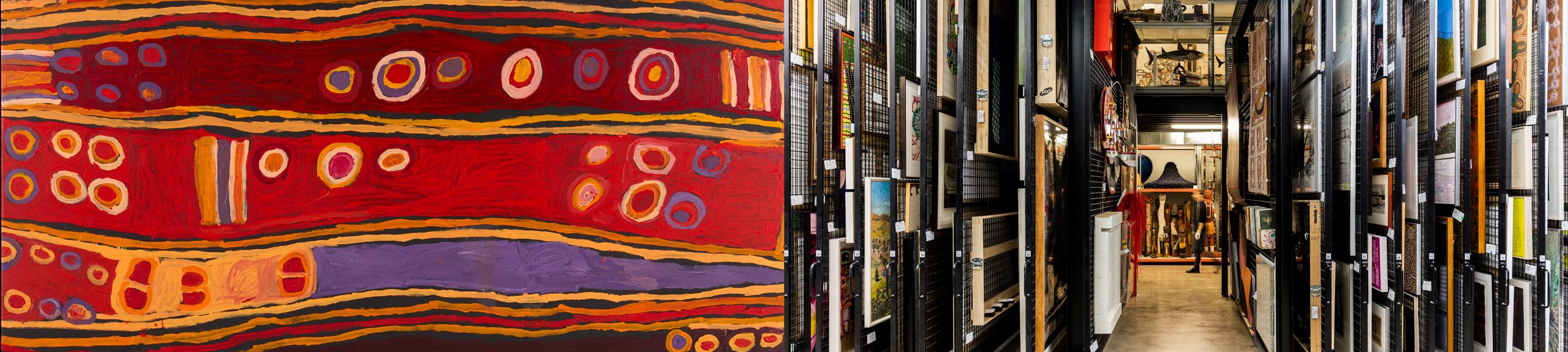
  • Michael Lindeman Paintings, Prints & Wall Hangings, 2007

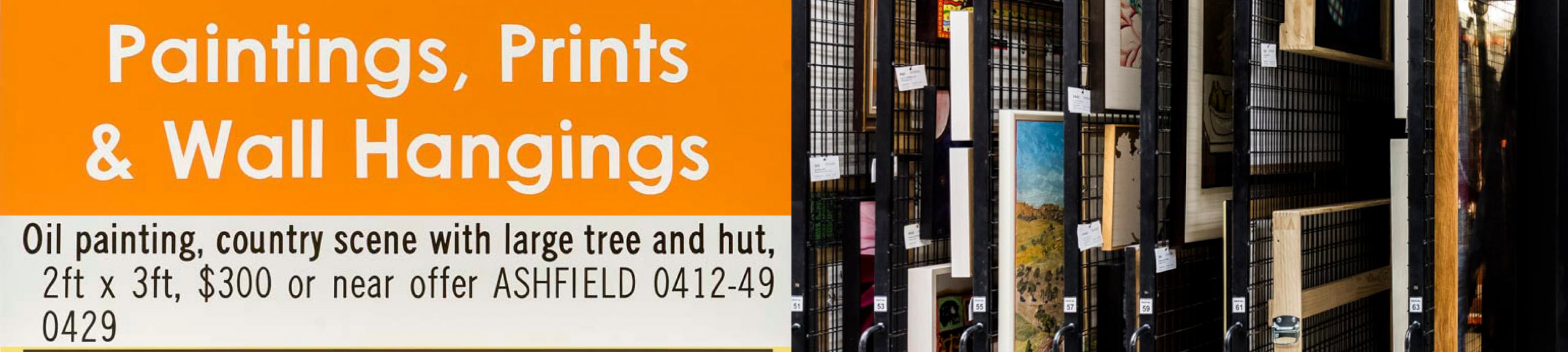
    (left) Detail of Michael Lindeman's 'Paintings, Prints & Wall Hangings', 2007. (right) Artbank Sydney's collection store. Photos courtesy of Artbank.

    And the Keyword is…..

    A behind the scenes look at Artbank’s keyword project for 2020.


    Imogen Dixon-Smith: Curator Artbank

    It is an unprecedented time for arts organisations, with galleries closed and events postponed across the country. Artbank staff have moved their offices into the home and with no artworks to move around except for those on our own walls, we have taken the opportunity to focus on some projects that had been on hold during busier times.

    Curatorial and Registration have commenced the enormous task of updating keywords for our collection of over 10,000 artworks. With the launch of our new website, the timing couldn’t be more ideal. Ensuring each artwork in collection has relevant keywords attached to its record in our Collection Management System will greatly enhance the discoverability of the Artbank Collection when searching for works online.

    We have prioritised the most popular sections of our collection, including photography and Aboriginal and Torres Strait Islander art to ensure the impact of the project will be realised as soon as possible. We closely assess the subject and attributes of each artwork and use a standardised thesaurus to select keywords relevant to the artwork. These keywords will provide more ways of searching and filtering through the collection.

    Refining the available terms to use as keywords has been a significant part of this project. The team has been faced with the complexity of categorising and defining certain styles and movements within contemporary Australian art. Our training as curators, artists and art historians has, on occasion, made us agonise over the use of simplified terms to describe artworks with expanded, innovative and experimental approaches to art making. However, we have greatly enjoyed the challenging discussion these issues have provoked to ensure our approach to keywords encompasses the multifaceted nature of our collection and allows for both general and specific ways of filtering and engaging with the collection.

    Once the project is complete, visitors to our website can look forward to searching the collection in a number of new ways. You will be able to find the perfect, picturesque landscape or a dynamic, abstracted painting by searching simple terms such as 'Landscape', 'Still Life' or 'Abstract'. For those clients interested in our Indigenous collection, you will be able to search for works by geographical region including 'Central and Western Desert', 'Torres Strait Islands' or 'Arnhem Land'. If there is a specific community or Art Centre you love, such Papunya Tula and their iconic acrylic paintings or the incredible barks skilfully painted by the Yirrkala masters, you will be able to find everything we have to offer.

    You can also search by place name to find an artwork depicting glorious 'Sydney Harbour' or the gritty laneways of 'Melbourne'. If you are keen on supporting unrepresented artists, you can browse artworks purchased through our 'Roadshow program' or, if supporting the practice of female artists is your focus, you can filter the collection by gender. Something our Art Consultants are very excited to hear is that if you are looking to fill a large wall, you can easily browse our selection of artwork series to find something fitting. The possibilities will be endless to delve into Artbank’s rich holding of Australian contemporary art.

    Browse the Artbank Collection now!

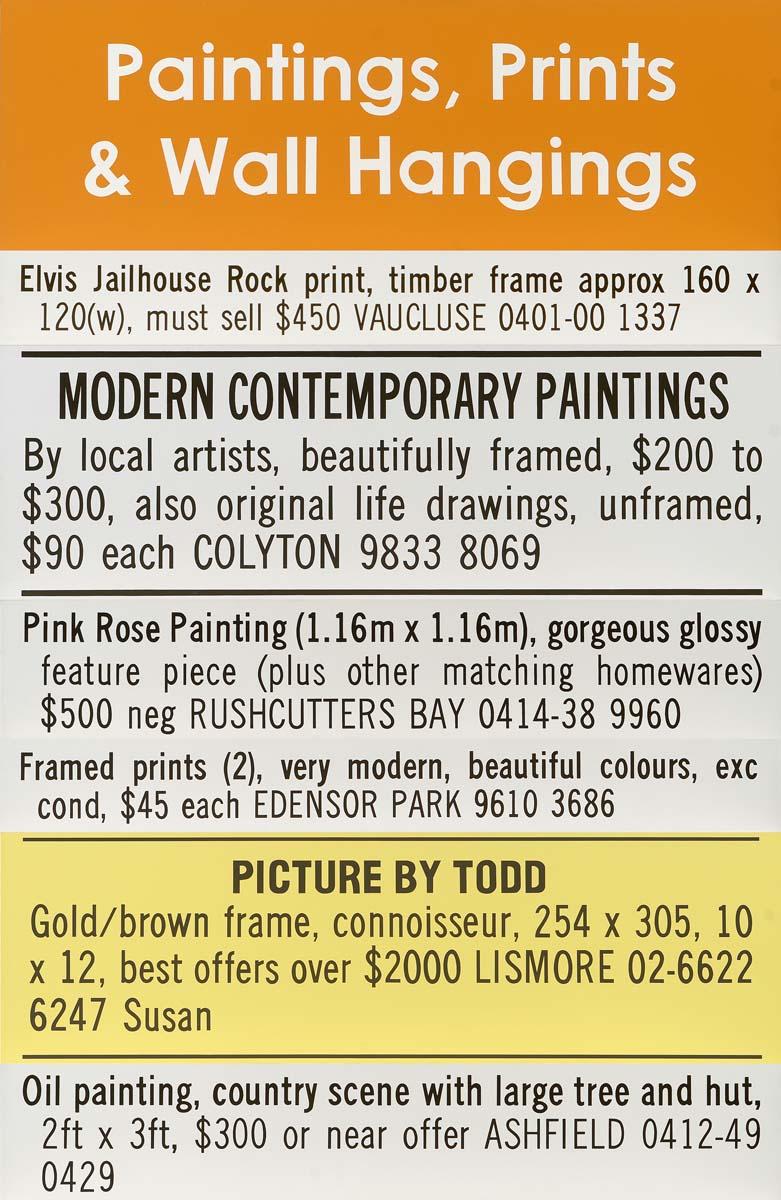
    Michael Lindeman, 'Paintings, Prints & Wall Hangings', 2007, Synthetic polymer paint on canvas

    Michael Lindeman Paintings, Prints & Wall Hangings, 2007 Synthetic polymer paint on canvas