Artbank acknowledges the Traditional Custodians of Country throughout Australia.
Warning: Aboriginal and Torres Strait Islander people should be aware that this website may contain images, voices or names of deceased persons in photographs, film, audio recordings or printed material.
Please view this in chrome if you are having any issues with how the website displays
Notice
This website uses cookies, utilised by us and third parties to enhance your experience. Learn more about how this website uses cookies on the departmental website.
News and Media
List of News and Media Articles
Karla Dickens, 'Pound-for-Pound #8', 2019, Aluminium, vintage mattock handle, waxed linen thread, cotton string, steel pulleys, emu feathers, steel, acrylic paint. Photo courtesy of the artist.
News
Announcement
Published on
17 July 2020
Karla Dickens
Pound-for-Pound#8 2019
Artbank is very excited to announce a new acquisition by Wiradjuri artist Karla Dickens. Pound-for-Pound #8 is part of a significant series included in the 2020 Biennale of Sydney, curated by artist Brook Andrew. The work is informed by Dickens’ research into Indigenous Australians who performed in circuses across the country. The symbolism makes powerful references to the black power movement and makes a bold statement of cultural assertion.
Senior Curator Dr Oliver Watts discusses this important new addition to the Artbank Collection.
Karla Dickens, a Wiradjuri artist, although being a stalwart of Australian art for decades, is perhaps finally finding her place as one of the most important contemporary Australian artists working today. This was a remarkable year for her, having been curated into both the Sydney Biennale by Brook Andrew and the Adelaide Biennale by Leigh Robb.
Having worked for over a year on both these significant bodies of work, Artbank took the opportunity to purchase one of her works in advance of the outings in the Biennales in order to support the artist in at least a small way in the lead up to these important career milestones. It was a great privilege to see a sneak preview of her work and to choose from these substantial bodies of work.
Artbank was drawn particularly to a series of sculptural work called Pound for Pound. The work is broadly figurative and approximates a standing figure. Made up of a variety of materials the main form of the work is a boxing glove cast in aluminium that stands in for a head placed on a steel armature.
Dickens uses found material a lot in her work to imbue her objects with a real sense of place and history. The artefacts, whether found wallpapers or Mattock handles, bear their previous life as a reified form of social history. Although the work must be read as a whole, the parts of the work can also be mined for historical and metaphorical value. In the Black Dog Series (2013), another work from the Artbank collection, you can see this process directed towards two-dimensional collage where Dickens uses old wallpapers, magazine imagery and other found surfaces.
In Pound for Pound the montage approach is brought to sculpture, with an extremely mysterious and resonant effect. Feathers, old string, steel cable, a vintage mattock and of course the cast aluminium glove all come together for the viewer to read. The work from a formal point of view is both powerful and soft, old and new, heroic but declassed, about the labouring man but also like a sacred relic.
The work is currently showing as part of a bigger installation, A Dickensian Circus in the ante rooms of the Art Gallery of New South Wales for Nirin. The space is turned into a form of carnival based on the stories of Indigenous Australians who were part of circus shows and tent-boxing troupes, especially between 1920 and 1960. It is a subject that Rhoda Roberts explored in her play Natives Go Wild. David Milroy’s play King Hit (1997) also brought the stories of Indigenous boxers to the stage.
There is no doubt that for many Indigenous boxers it was a road to money and fame and to a level of autonomy away from the eyes of the Protection Board. But of course there were still hardships surrounding the pressures of entertainment and exploitation and the level of travelling lead to a distancing from family and homelands. The athleticism of Indigenous people was celebrated though, Lionel Rose and Tony Mundine and many others begun their sporting lives as part of troupes.
Tony Mundine is quoted as saying, "Back in the days we were poor and had no money for stuff so when these shows come to Grafton it was always a big deal…I was climbing the ladder so quickly I was knocking everyone out. I had 25 knockouts in a row. It was big cash my friend, big cash.”
The title of this piece comes from the boxing troupe siren call, “A round or two for a pound or two.” Even the title therefore equivocates: A pound of flesh, a pounding for a pound. The Nirin catalogue notes describe the work in this way:
“…evoking the charged context of the circus and its complicated historical legacy of entertainment and spectacle, agency and entrapment….She uses recycled everyday items to explore notions of persistence amidst inherent violence and misunderstanding. Made with uncommon rawness and daring, her meticulously fabricated works emanate a rare truthfulness and honesty.”
In the present climate the work not only looks back but forward as a strong piece of political power and agency. The fist is reminiscent of the clinched fists of the Black Power movement; the strength of the works, especially massed as a group in the foyer of the gallery, are like a phalanx of fighters confronting the gallery goer. We are proud that at least part of this powerful installation will have a continuing force within the Artbank Collection and tell its story of Indigenous rights and cultural identity in Australia and abroad for years to come.
Karla Dickens is a Wiradjuiri artis, born in Sydney 1967 and currently living and working in Lismore, NSW.
Commissioned by the Biennale of Sydney with generous support from the Australia Council for the Arts, Copyright Agency’s Cultural Fund, and Create NSW, and generous assistance from Justine and Damian Roch.
Pound for Pound #8 will be available through Artbank leasing program at the close of the exhibition. For more information contact Artbank.
Describe your role and what you enjoy about working for Artbank: I joined Artbank in 2010 having moved to Sydney from Brisbane where I had worked as Senior Registrar of Collections at QAGOMA. My role at Artbank oversees the care and protection of the Artbank Collection in the art storage facilities in Sydney, Melbourne and Perth. This involves leading a busy Registration team in the functions of acquisitions, loans, packing, international shipping, conservation care, transport and installation.
Favourite artwork from the Artbank Collection: #1227, Howard Arkley, Printout, 1981
Short explanation of your artwork selection: I have always admired this painting by Howard Arkley. Printout is a highly accomplished painting by an artist that absolutely mastered an airbrushed technique that leaves no room for errors in execution. It reminds me of decorative pattern making of crafts such as embroidery or needlework that my mum used to do when I was growing up. Interestingly Arkley had used this pattern a year earlier on one of 40 Trams painted by Australian artists that screeched their way around Melbourne streets during the 1980s. I like how the dots cleverly alternate between black and grey to give sharpness and softness to the airbrushed surface while the blue and red oscillate for space. The stencilled lines and shapes seem to float off the canvas.
For me this artwork is also a great example of the importance and significance of the Artbank Collection to the very grassroots of the Australian arts community. Purchased in 1981 Howard Arkley was an emerging mid-career artist rising in prominence, and it was going to be another 18 years before he went on to represent Australia at the 48th Venice Biennale with his more iconic lurid spray paint images of suburbia. Artbank was supporting Arkley at the early stages of his career and this is what I like about the Artbank collection. Since 1980, Artbank has supported artists at the beginning of their careers, and in doing so has established one of the most interesting collections in Australia, made accessible for everyone.
Howard Arkley, 'Printout', 1981, Synthetic polymer paint on canvas
Share this page
Staff Profile
Published on
5 May 2020
Name: Zoë Rodriguez
Job Title: Director
What year did you join the Artbank team: 2019
Describe your role and what you enjoy about working for Artbank:
As the director, I am responsible for leading Artbank’s strategic direction and making sure we live up to our two key policy objectives of supporting the Contemporary Australian art sector through acquisition of works, and providing broad community access to Australian Art through the art leasing scheme. It involves a lot of listening, reading and analysing a lot of reports and accounts, and making decisions with the team that will help us meet our key objectives.
There is no doubt that one of the greatest joys of working for Artbank is having the opportunity to wander the racks of Australian art. Artbank’s eccentric nature – with works constantly coming and going and being stored where space is available when they arrive, rather than by any traditional art categorisation system – means you can be travelling past media, styles, decades and thousands of kilometres with one sweep of your eyes. I also delight in working for a public institution that continues to deliver successfully on its two key public policy objectives and that can bring such joy to so many through its work. Artists always recount the first acquisition Artbank made of their work with huge fondness (often this seems to have marked their feeling of acceptance and arrival on the contemporary art scene). Then there are our clients, who tell us how much their staff and visitors love to engage with Artbank works – they start conversations and create lively atmospheres in spaces that can otherwise be alienating and sterile.
This work evokes my childhood home and breakfast table and especially my mother’s feminism and activism through her art and poetry, and of course chimes in with the questions we are all asking in the wake of the MeToo movement. I grew up hearing about the choices women made and the reasons my mother decided on her own path. She encouraged me not to be constrained by traditional ideas of what a woman (or anyone for that matter) should do and be. I love the liveliness Hattam gives to domestic objects and her merging of the interior world with the exterior.
Describe your role and what you enjoy about working for Artbank:
My role at Artbank is to look after and help maintain the collection. This involves condition reporting artworks, making sure the collection store is always looking presentable, packaging, transporting and installing artworks for clients. Effectively it’s my job to work behind the scenes and provide quality assurance. I really enjoy how hands on and involved my role is in the handling of artworks and the problem solving that comes with the territory – I’m surrounded by an amazing cohort of artis’s works every day and have the privilege of interacting with the clients as we ‘unveil’ and install their chosen artworks.
Favourite artwork from the Artbank Collection: #13706, Hayden Fowler, New World Order, 2013
Short explanation of your artwork selection:
Heritage-breed chickens and exotic birds within uncanny, dystopian spaces - emitting strange electronic squawks and cackles!
Describe your role and what you enjoy about working for Artbank:
I work in the Artbank collection store and do most of the Artbank installs in Sydney. I look at the storage and installation of Artbank artworks to make sure they are safe and secure and can be enjoyed for generations to come. It is great to be a part of a team that supports Australia’s artists and arts industry
Favourite artwork from the Artbank Collection: #13524, Robert Pulie, W (version 3), 2012
Short explanation of your artwork selection:
I really like this work because of its form and materials. I have always been interested in the idea of perception, and this work has a great play on a true image. By having the mirrors in a “W” configuration there is not the reversal in the image like a flat mirrors shows. The work’s tasteful fixtures really evoke the idea of a vanity dresser, something we use to look at ourselves. The work becomes a point of self-reflection on more than one level… who doesn’t like a work where they can truly look at themselves!
Robert Pulie, W (version 3), 2012, Mirror, copper, brass bolts and cedar
Share this page
Staff Profile
Published on
5 May 2020
Name: Natalie O’Connor
Job Title: Marketing and Communications Manager
What year did you join the Artbank team: 2018
Describe your role and what you enjoy about working for Artbank:
Artbank inserts art into the everyday! It is great to see contemporary Australian art taking up a much more personal space in the lives of the broader public. Placing artworks in office spaces, living rooms, hallways, foyers and all kinds of private and public spaces means people can encounter artworks in their everyday, rather than on the stuffy white walls of a gallery. It is great to be part of this process. My role as Communications Manager allows me to share all the wonderful stories from the Artbank collection.
The Artbank collection is uniquely Australian, growing and changing constantly and in many ways, commenting and reflecting on the issues of the time. It is a collection that has a great sense of humour and fun but is also not afraid to speak to confronting issues. I am particularly passionate about the beautiful and varied collection of works by Aboriginal and Torres Strait Islander artists. It is incredible to work with such powerful and important artworks every day.
Favourite artwork from the Artbank Collection: #14430, Elvis Richardson, Slide Show Land "Dorothy", 2005
Short explanation of your artwork selection:
I have selected Elvis Richardson, Slide Show Land “Dorothy”, because…..those boots!
Describe your role and what you enjoy about working for Artbank:
I commenced at Artbank as a temp receptionist, back when Artbank was located in Rosebery and handwritten telephone notes were used instead of email. Having come from a performing arts background, I developed a real passion for Artbank’s objectives and delighted in bringing Artbank up to speed with innovative administrative processes. As an avid people organiser (and people pleaser) I have been fortunate to work across many roles during my time at Artbank. I have attended professional development programs in public sector leadership and management which, together with my knowledge of the organisation, gives me the skills to manage the administrative and governance functions of Artbank, leading the administration team to provide excellence in finance and accounts management, client management, human resources, office administration and IT whilst ensuring Artbank is compliant with the whole of government requirements.
Okay so the title Rikina Kungka Kutju (One Really Cool Lady) almost put me off selecting it. You see I love this work for its representation of the strength that women share when they support each other, but I am definitely not One Really Cool Lady, unless you consider looking after house plants, wrangling children and drinking bubbles as cool. Kaylene Whiskey has become known for her bold, comic book-style paintings in which everyday fantastical narratives with a feminist undertone convey stories from the Indulkana community and Whiskey’s own day to day experiences, played out with characters from western popular culture.
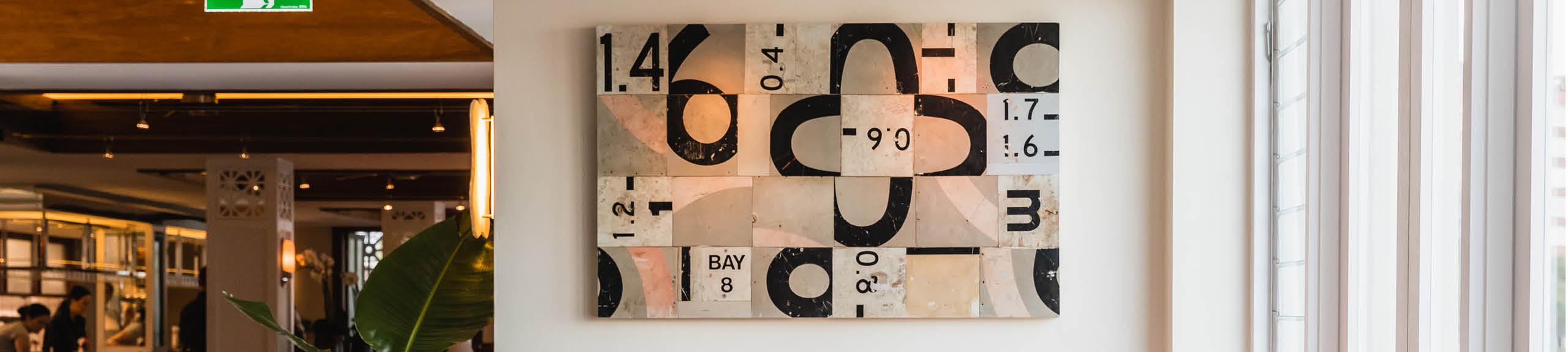
Installation view, Artbank client Bather's Pavillion featuring artworks by Peter Quinn, Sydney, 2019. Photo: Nikki To.
Client Testimonial
Published on
16 October 2019
Interior designer Rachel Luchetti from Luchetti Krell approached Artbank about a special project which required a careful selection of artwork. The iconic Bather’s Pavilion in Mosman, framed by two palm trees overlooking the Sydney Harbour, was undergoing a substantial renovation and needed artworks which complemented the 1920s architecture. Our dedicated art consultant who has more than 15 years of experience working at Artbank Courtney Kidd, took on the project and began working closely with Rachel and the co-owners of the Bathers Pavilion, Ian and Maryanne Pageant. Rachel, Ian and Maryanne visited our collection in Waterloo and selected artworks which would enhance the new interior space. It was important they captured a nostalgia that was sympathetic to the modernist style of the building while still being resolutely contemporary.
“The redesign is more of a sensitive evolution than complete reinvention of this much loved Balmoral Beach gem…Custom and designer furniture pieces needed to be carefully curated amongst artworks and objects that are thought provoking and emotionally moving” - Rachel Luchetti, interior designer
Installation view, Artbank client Bather's Pavillion featuring artwork by Sarah Robson, Sydney, 2019. Photo: Nikki To.
Courtney then created a list of potential artworks which she presented to Rachel and the co-owners. After careful consideration, 25 pieces were selected to be featured throughout the building.
“The client wanted to create a sense of a private well-loved collection that would contemporise the spaces while acknowledging an aspect of its history. What resulted was a terrific collection of artworks that would engage patrons and enliven the space” - Courtney Kidd, Artbank art consultant
Amongst the artworks chosen for the space included Jeffery Smart’s The Overpass, 1966-67 which is situated in the dining room. The work explores an unsettled urban environment which exemplifies both the surreal and formal qualities of modern city architecture, from freeways to industrial wastelands.
Installation view, Artbank client Bather's Pavillion featuring artwork by Jeffrey Smart, Sydney, 2019. Photo: Nikki To.
Another striking artwork is John Kelly’s Two heads and a sky painting showing two cows which represents the Australian landscape and the narratives of settler history and pastoral production. Eighty-nine Parrots by Rosalie Gascoigne is situated in the intimate dining room opposite the Jeffrey Smart painting. Rosalie Gascoigne was a Canberra based artist whose work captured the surrounding landscape of the Monaro region landscape which inspired her abstract assemblages. A Katherine Hattam work The Rights and Wrongs of Women which can be seen in the larger dining room reflects the struggles women face trying to juggle the demands of family and professional life. These are just a glimpse into the breadth of work available in the Artbank collection. Some of the more contemporary artworks were selected for their thematic and material relevance to the seaside including the sculpture Ice Cream Van by Marc Etherington, Ken Done’s oil painting Hot Wednesday and the sculpture Aurukun Bicycle by Jean Walmbeng which uses recycled nets and ropes mounted on the wall above the entrance.
“The mixture of paintings and sculptures are playful yet thoughtful while capturing the essence of the unique space. I’m so glad we were able to showcase these talented Australian artists in such an iconic building. To be part of this renovation is to be part of history and Artbank is proud to have played such a key role” - Courtney Kidd, Artbank art consultant
Installation view, Artbank client Bather's Pavillion featuring artworks by Peter Quinn, Sydney, 2019. Photo: Nikki To.
The artworks were installed by our meticulous Artbank team Matthew James and Jack Harman throughout multiple rooms including The Bistro, The Sunroom, Lounge, Restaurant and The Kiosk. The installation occurred in the days leading up to the grand opening of the new Bather’s Pavilion so visitors were able to enjoy the completed interior design.
Artbank registrars Matthew James and Jack Harman installing Jeffrey Smart, 'The Overpass', 1966-67. Oil on canvas at the Bather’s Pavilion.
If you are interested in leasing artwork from us email enquiries@artbank.gov.au or call 1800 251 651.
Share this page
(left to right): Emerging curators Sophia Cai, Sabrina Baker and Anja Loughhead. Portrait of Sophia Cai by Pia Johnson, 2017.
Announcement
Published on
18 September 2019
Three dynamic emerging curators will explore themes of love, labour and the workforce in two new exhibitions as part of Artbank’s Emerging Curator program. With the assistance of Artbank, the curators will produce exhibitions in 2019 and 2020 for the public showcasing some of Australia’s best contemporary art held in the Artbank collection.
Sophia Cai is a Melbourne based independent curator with a particular interest in Asian art history, feminist methodologies and community-based practices. Ms Cai will work closely with Artbank’s curators to develop her upcoming exhibition The Four Letter Word which will open later this year at Artbank’s Sydney premises.
“It’s an incredible opportunity to curate the ‘Four Letter Word’ as part of the Artbank Emerging Curator’s Program. It will give me the chance to work for the first time in my career with a permanent collection. I look forward to exploring the theme of love whether it be platonic, familial or romantic and bringing together artworks from a diverse range of artists,” said emerging curator Sophia Cai.
Sabrina Baker and Anja Loughhead are a collaborative team based in Melbourne and the ACT. Their new exhibition will examine society’s concept of labour which will open at Artbank’s Sydney premises in early 2020.
“It will be a fantastic opportunity to work with Artbank – one of Australia’s largest collections of contemporary Australian art. There are so many incredible works which really unpack the idea of labour and the link between success and failure,” said emerging curator Sabrina Baker.
“Artbank’s emerging curator program is one you want to be part of. Their support and guidance is invaluable as we push the boundaries and develop fresh perspectives. We’re thrilled to work on such a professional, poignant exhibition,” said emerging curator Anja Loughhead.
The program began in 2018 and aims to assist emerging curators gain experience within a professional institutional environment and work with Artbank’s impressive collection of contemporary Australian art. The previous recipients are Eleanor Scicchitano and Talia Smith. Applications for the next round will open in 2020 for exhibitions in 2021.
Established in 1980, Artbank is an Australian Government arts support program. The program aims to increase the sustainability and accessibility of Australian contemporary art through initiatives such as the leasing scheme.
Share this page
News
Announcement
Published on
27 August 2019
ACMI (Australian Centre for the Moving Image), together with Artbank, is excited to announce Reko Rennie as the recipient of the second $70,000 Artbank + ACMI Commission for his proposed new video work,What Do We Want.
Shot on cinematic 4K, What Do We Want will draw on 1970s Blaxploitation films and Rennie’s own martial arts practice to explore political, environmental and social questions through an Aboriginal Australian lens.
“I’m very excited and honoured to be offered this award by Artbank + ACMI to make my new video work, 'What Do We Want'. This commission is an amazing opportunity to create a new work that I’ve wanted to make for some time and I look forward to sharing it with you,” said Rennie.
ACMI Director and CEO Katrina Sedgwick said: “Reko Rennie is a vital voice at the forefront of Australian contemporary art and we are thrilled to award Reko the Artbank + ACMI Commission, providing him with the support to pursue and extend his practice. Reko’s probing cinematic artworks defy categorisation and it’s exactly these types of works that the Artbank + ACMI Commission was designed for.”
Artbank Assistant Director, Emma Crimmings said: “We’re proud to have Reko Rennie as the next recipient of the Artbank + ACMI Commission. We look forward to connecting the outcomes of this project to the broader public through our art leasing program.
“Reko Rennie is one of Australia’s most exciting multi-disciplinary artists and through his new work, 'What Do We Want' we anticipate Reko will emerge as a powerful and timely voice in 2020. Set in a dojo studio and paying homage to Blaxploitation films of the 70s, What Do We Want is a highly stylised and choreographed examination of urgent questions facing Aboriginal people today,” said Crimmings.
Established in partnership with Artbank, the federal government’s flagship support program for Australian contemporary artists, the Artbank + ACMI Commission is a three-year commissioning program that will enable Australian artists and filmmakers to create new works that are conceived at the intersection of art and cinema.
This partnership further expands ACMI’s vibrant commissioning program, which through a series of vital collaborations – with Artbank, Ian Potter Foundation, City of Melbourne and the Mordant Family – will directly fund Australian artists with $650,000 worth of financial support to create new work over the next three years and then exhibit it to thousands of people at ACMI and beyond.
What Do We Want will be exhibited at ACMI in 2020. For more information, visit acmi.net.au/commissions
Reko Rennie at Sydney Contemporary 2018. Photo: Jacquie Manning
Media Contact: Zoe Shurgold – ACMI Head of Communications media@acmi.net.au 03 8663 2415 0415 254 418
About Reko Rennie
Born in Melbourne in 1974, Reko Rennie is a self-taught interdisciplinary artist who explores personal and political narratives through the lens of his own Aboriginal (Kamilaroi/Gamilaroi) heritage and broader cultural themes around power, identity, memory and history. Rennie’s works are largely autobiographical, often combining the iconography of his Kamilaroi heritage with contemporary media that includes painting, sculpture, installation and filmmaking.
About ACMI commissions
ACMI has proven itself an astute commissioner, with a particular focus enabling leading practitioners to engage in cross-disciplinary collaboration. The $100,000 biennial Ian Potter Moving Image Commission has supported Angelica Mesiti’s The Calling (2014), Daniel Crooks’ Phantom Ride (2016) and was most recently awarded to Gabriella Hirst for her proposed work Darling Darling (working title) that will premiere in 2020. ACMI’s exhibitions program has commissioned many works including Julian Rosefeldt’s critically acclaimed Manifesto (2015) and Soda_Jerk’s critically acclaimed TERROR NULLIUS (2018).
In 2016, ACMI co-commissioned and premiered virtual reality experiences of Sandpit’s play Ghost, Toast and the Things Unsaid with Google Creative Lab and Grumpy Sailor, and Stuck in the Middle With You, an immersive dance experience by choreographer Gideon Obarzanek and award-winning filmmaker Matthew Bate. In 2017, ACMI premiered cross-disciplinary VR co-commission Prehistoric VR by Sydney-based puppetry company Erth.
In 2019, ACMI held a VR Showcase featuring two Mordant Family VR Commissions: Dr Christian Thompson’s Bayi Gardiya (Singing Desert) and Joan Ross’s Did you ask the river? alongside the acclaimed VR work Awavena by Lynette Wallworth. Tully Arnot Epiphytes (working title) is the third and final recipient of the Mordant Family VR Commission. More at acmi.net.au/commissions
About Artbank
Established in 1980, Artbank’s two core objectives are to support Australian contemporary artists through the acquisition of their work and to promote the value of Australian contemporary art to the broader public. The Artbank collection is comprised of approximately 10,000 works by over 3,500 artists, across media, and includes some of the best examples of Indigenous and non-Indigenous Australia art produced over the last four decades. Artbank makes this work accessible through an art leasing program which is accessed by corporate, private and government clients nationally and internationally. More at artbank.gov.au
About ACMI
ACMI (Australian Centre for the Moving Image) is Australia’s national museum of film, TV, video games, digital culture and art and the world’s most visited moving image museum. Situated in the very heart of Melbourne, Fed Square, ACMI closed its doors this year to undergo a visionary redevelopment that will transform the museum into one of the world’s leading public institutions for screen culture and innovation, connecting audiences of industry, education and the public. ACMI will reopen mid 2020. More at acmi.net.au/renewal